 +1 408-915-6865
True Appliance Fault Code Professional Guide
When a True appliance shows an error code, it usually means the equipment has detected a fault in one of its main operating systems. On True commercial refrigerators and merchandisers, these alerts usually point to temperature instability, sensor failures, condenser problems, voltage issues, door alarms, communication faults, or refrigerant-related conditions.
This page is designed to help business owners and food-service operators in the Bay Area understand what these codes usually mean, which equipment systems they point to, and when it makes sense to request professional service. It is not a full repair manual. It is a practical overview of the most common True appliance error code patterns.
Hotline Appliance Repair provides local commercial appliance repair in the Bay Area for major refrigeration equipment, including True commercial refrigerators and merchandisers.
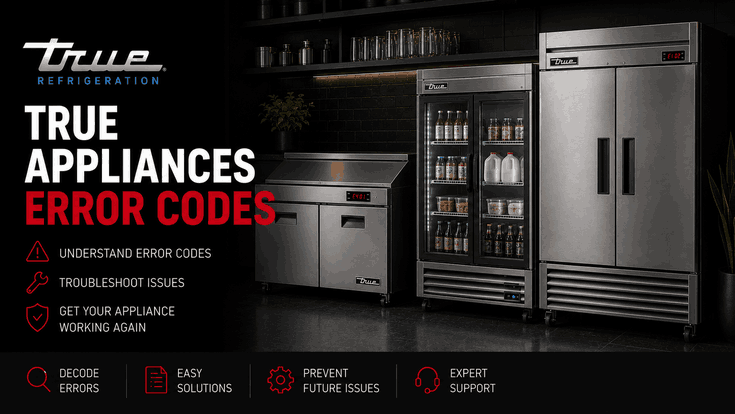
What True Appliance Error Codes Usually Mean
A True error code is not always a final diagnosis. In most cases, it is a warning that helps narrow the issue to one system. One alert may point to a temperature alarm. Another may indicate a probe failure, a condenser issue, a communication fault, or a supply-voltage problem.
That is why it is more helpful to read these codes by category. On True commercial refrigeration equipment, the most common code families usually involve temperature alarms, door-open alerts, sensor and probe failures, condenser warnings, voltage problems, communication errors, and leakage or refrigerant-related conditions.
Common True Refrigerator Error Code Families
Temperature Alarm Codes
Codes: 1-1 / HI / LO / Hi / Lo / HA / LA
This is one of the most important True refrigerator code groups because it directly affects holding conditions inside the cabinet. These alerts usually point to temperatures moving too high or too low for normal operation.
In commercial use, that may mean unstable product temperature, weak cooling recovery, or storage conditions that need quick attention.
Other True Refrigerator Code Groups
Voltage Alarm Codes: 1-2 / uHi / uLi / uLo / Ulo / UHi
These alerts usually point to supply-voltage problems or incoming power outside the expected range.
Condenser Alarm Codes: 1-3 / Con
These codes usually indicate a condenser warning, restricted airflow, or a condition that can affect cooling performance.
Sensor and Probe Error Codes: 2-1 / E0 / E1 / E2 / E01 / E02 / E03 / E04 / P1 / P2 / P3
These alerts usually point to sensor failures, probe faults, or temperature-reading problems inside the unit.
Potentiometer-Related Codes: 2-2 / E6
These codes usually relate to a potentiometer issue or control input problem.
Leakage and Refrigerant Alarm Codes: 3-1 / LEA
These alerts may point to leakage warnings or refrigerant-related conditions that can affect cooling reliability.
Door-Open Alarm Codes: dOr / dor / dA / do
These codes usually indicate a door-open condition or a door that is not closing properly.
Defrost-Related Code: Ed
This code usually points to a defrost-related issue that may affect normal refrigeration performance.
Communication and Display-Related Codes: EoC / E13 / non / SYn
These alerts usually involve communication faults, display issues, or synchronization problems between controls.
Compressor and Heater Fault Codes: E4 / E5
These codes usually point to compressor-related faults, heater issues, or operating problems inside the refrigeration system.
Memory, External, and Pressure Alarm Codes: EE / EAL / BAL / PAL
These alerts usually involve memory faults, external alarm conditions, backup alarm conditions, or pressure-related warnings.
Common True Merchandiser Error Code Families
Door, Temperature, and Probe-Related Codes
Codes: do / hi / Lo / E1 / E2 / E3
This is the main True merchandiser code family because it covers the problems that most often affect display cooling performance. These alerts usually point to an open-door condition, temperature moving outside the normal range, or a failed probe.
In commercial use, that may show up as warming product, unstable case temperature, or inconsistent operation during business hours.
Other True Merchandiser Code Groups
Health Safety Alarm / Lockout Codes: hLA / Loc
These alerts usually point to a health safety alarm, lockout condition, or system state that may prevent normal operation.
Power Failure Code: PF
This code usually indicates a power failure or electrical interruption that affected the merchandiser.
What Businesses in the Bay Area Should Do First
Check the code together with the equipment’s actual behavior. Look for rising temperature, repeated door alarms, weak cooling, display issues, or recurring power-related alerts.
If the same code keeps returning, the unit usually needs more than a reset.
Local True Commercial Refrigeration Error Code Help in the Bay Area
Repeated True refrigerator and merchandiser error codes usually mean the equipment is dealing with a deeper system problem. If your True commercial unit keeps showing the same alert, professional commercial appliance service can help identify the cause and the next repair step.
Call Hotline Appliance Repair to Book Your Service
Phone: +1 408-915-6865
Address: 665 Nido, Campbell, CA 95008
Email: hotlineappliancerepair@gmail.com
Open Hours: Monday – Sunday: 8:00 AM – 8:00 PM
True Fault Groups for Bay Area Commercial Cooler Diagnostics
This True code table gives Bay Area restaurants, cafés, markets, and food-service teams a clear way to read alerts from commercial refrigerators, freezers, coolers, and merchandisers. Hotline Appliance Repair uses the chart to connect repeated warnings with real equipment patterns such as temperature alarms, voltage issues, probe failures, condenser restrictions, refrigerant alerts, door-open conditions, defrost faults, compressor problems, power loss, and display communication errors. For official model documents, compare the code with True’s Service and Installation Manuals library.
| Error Code | Appliance | Meaning | Safe first steps | Technician required | Related help |
|---|---|---|---|---|---|
| 1-1 | Commercial Refrigeration | Low and high temperature alarm. | Verify actual cabinet temperature, clean the condenser coil if dirty, confirm airflow and clearance, check door or drawer sealing, and verify fan operation. | Yes — if the alarm returns after those True pre-diagnosis checks. | True Commercial Refrigeration Door Open, High Temp, and Condenser Alarm Problems |
| 1-2 | Commercial Refrigeration | Line voltage alarm. | Verify incoming line-to-neutral voltage at the control, inspect for voltage drop, and correct any supply issue before replacing controls. | Yes — if supply voltage is correct and the alarm remains active. | |
| E0 | Commercial Refrigeration | Probe 1 error. | Check thermostat-probe connection and resistance at the probe location; use an ice bath / resistance check if needed. | Yes — if probe 1 or its harness fails the resistance test. | True Commercial Refrigeration Probe Sensor Errors E0, E1, E2, P1, P2, and Temperature Reading Faults |
| E1 | Commercial Refrigeration | Probe 2 error. | Check the defrost-probe connection and resistance at the evaporator/coil location. | Yes — if probe 2 or its wiring is defective. | |
| Hi | Commercial Refrigeration | High temperature alarm. | Check condenser cleanliness, cabinet airflow, door sealing, fan operation, and recent stocking/load conditions before deeper refrigeration diagnosis. | Yes — if the appliance does not pull back to temperature. | |
| uHi | Commercial Refrigeration | High voltage alarm. | Verify incoming supply voltage and look for line-side overvoltage before replacing any control parts. | Yes — if measured voltage is normal but the code returns. | |
| uLi / uLo | Commercial Refrigeration | Low voltage alarm. | Verify incoming supply voltage, inspect for voltage drop, loose connections, and branch-circuit issues. | Yes — if the unit has correct voltage and still reports low-voltage alarm. | |
| E4 | Commercial Refrigeration | Compressor fault. | Verify compressor voltage line-to-neutral, check load-side voltage out of the control, and separate control issues from compressor/refrigeration issues. | Yes — if compressor power and wiring test correctly but the fault remains. | |
| E5 | Commercial Refrigeration | Heater fault. | Check defrost-heater circuit continuity and operation, and inspect the associated wiring/connectors. | Yes — if the heater circuit is open or not operating correctly. | |
| HA | Commercial Refrigeration | Maximum temperature alarm. | Check condenser cleanliness, airflow, door sealing, fan operation, and recent loading conditions before moving to refrigeration diagnostics. | Yes — if the unit does not recover to normal temperature. | |
| LA | Commercial Refrigeration | Minimum temperature alarm. | Verify product temperature, set point, and probe accuracy before suspecting a control or refrigeration issue. | Yes — if the cabinet continues operating below target temperature. | |
| Lo | Commercial Refrigeration | Low temperature alarm. | Verify actual product temperature, review set point, and inspect probe feedback and control cycling. | Yes — if the cabinet remains too cold after those checks. |
